

How Provably Fair Gaming Works: A Beginner's Guide
by SLM.Games Team
If you have ever wondered whether an online casino game is truly fair, you are not alone. Traditional casinos ask you to trust that their Random Number Generator has been audited by a third party. Provably fair gaming takes a completely different approach — it gives you the tools to verify every single result yourself, using math instead of trust.
This guide explains how provably fair works in plain English, why it matters, and how you can use it at SLM.Games.
The Problem with Traditional Online Casinos
Most online casinos use a Random Number Generator (RNG) that is certified by an auditing firm. The audit happens periodically — maybe once a year — and you, the player, have no way to check individual results. You are trusting the casino, the software provider, and the auditor all at once.
This model works, but it requires a lot of trust. What if you could remove trust from the equation entirely?
What Is Provably Fair?
Provably fair is a system where the casino commits to a game result before you place your bet, and then proves after the round that the result was not changed. It uses the same SHA-256 cryptographic hashing that secures Bitcoin and other blockchains.
The key insight is simple: if the casino locks in the result before your bet, it cannot cheat. And if you can verify the lock, you do not need to trust anyone.
The Three Ingredients
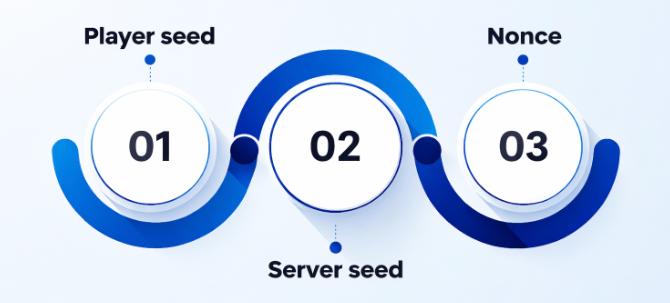
Every provably fair game at SLM.Games uses three inputs to generate a result:
1. Server Seed
The server seed is a random string generated by SLM.Games. Before you bet, the casino shows you the SHA-256 hash of this seed — a one-way fingerprint that commits the casino to a specific value without revealing it. After the round, the actual server seed is revealed so you can verify it matches the hash.
2. Client Seed
The client seed is a random string chosen by you (or auto-generated by your browser). Because the game result depends on both the server seed and your client seed, the casino cannot predict or manipulate the outcome — it does not know your client seed when it commits to the server seed.
3. Nonce
The nonce is a simple counter that goes up by one with every bet you make under the same seed pair. It ensures that even if you keep the same client and server seeds, every single bet produces a different result.
Step-by-Step: How a Provably Fair Bet Works
Here is what happens behind the scenes every time you place a bet:
- Commit — The server generates a random seed and shows you its SHA-256 hash. This is a binding commitment: the seed is locked.
- Bet — You place your bet. Your client seed and the current nonce are combined with the server seed to generate the game result.
- Reveal — After the round, the server seed is disclosed. You now have all three inputs.
- Verify — Hash the revealed server seed with SHA-256. If it matches the hash you were shown before the bet, the seed was not tampered with. Then combine all three inputs to reproduce the result and confirm it matches what was played.
Why Can't the Casino Cheat?
The security comes from the properties of SHA-256 hashing. A hash is a one-way function: you can easily compute the hash of any input, but you cannot reverse-engineer the input from the hash. If the casino tried to change the server seed after seeing your bet, the hash would no longer match — and you would know instantly.
Additionally, because the result depends on your client seed, the casino cannot pre-calculate a favorable outcome. It committed to its seed before knowing yours.
How Each Game Uses Provably Fair
While the core seed-and-hash mechanism is the same, each game at SLM.Games maps the cryptographic output to its specific mechanics:
- Dice — The combined hash generates a number between 0 and 99.99, compared against your chosen threshold.
- Crash — A chain of SHA-256 hashes determines each round's crash multiplier. The hash chain is published in advance.
- Limbo — Same algorithm as Dice, but maps the output to a multiplier that is compared to your target.
- Blackjack & Baccarat — Card positions are derived from sequential hash bytes, producing a fully verifiable shuffle.
- Plinko — Each pin bounce direction (left or right) comes from a sequential byte of the combined hash.
- Mines — Mine positions on the 5x5 grid are placed using a Fisher-Yates shuffle derived from the seed hash.
- Roulette — The winning pocket is the combined hash modulo the number of pockets.
- Keno — The 20 drawn numbers are selected using sequential hash bytes from an 80-number pool.
- Wheel — The winning segment is determined by mapping the hash to the wheel's segments.
How to Verify Your Bets on SLM.Games
Verifying a bet is straightforward:
- Open any completed bet from your bet history.
- Copy the client seed, server seed, and nonce.
- Use our built-in verification tool under each game, or look into our opensource code on the provably fair page.
- If the reproduced result matches the game outcome, the bet was fair. If you hash the server seed and it matches the pre-committed hash, the seed was not tampered with.
Provably Fair vs Traditional RNG: A Quick Comparison
| Traditional RNG | Provably Fair | |
|---|---|---|
| Verification | Periodic third-party audit | Every bet, by anyone, instantly |
| Transparency | Algorithm is hidden | Algorithm is public |
| Trust model | Trust the auditor | Trust the math |
| Player influence | None | Client seed affects the outcome |
| Tampering detection | Not possible for players | Instant — hash mismatch reveals it |
Frequently Asked Questions
Can I change my client seed?
Yes. You can set a new client seed at any time. When you do, the server also generates a fresh server seed and reveals the old one, so you can verify all previous bets made under that seed pair.
Does the house still have an edge?
Yes — provably fair does not eliminate the house edge. It guarantees that the stated odds are real. For example, if a Dice game says you have a 49.5% chance of winning at 2x, provably fair proves that is exactly what you get. No hidden advantage, no rigged outcomes.
Do I need technical skills to verify?
No. SLM.Games provides a built-in verification tool under each game. Paste your seeds and nonce, and it shows you the result. If you want to go deeper, the algorithm is opensource and available on our provably fair documentation.
Which games at SLM.Games are provably fair?
All 10 original games: Dice, Crash, Limbo, Blackjack, Baccarat, Plinko, Mines, Roulette, Keno, and Wheel.
The Bottom Line
Provably fair technology is the gold standard for online gambling transparency. It replaces blind trust with cryptographic proof, giving every player the power to verify every bet. At SLM.Games, all original games are provably fair — so you can focus on playing, knowing the math is on public record.
Ready to try it? Browse our games and place a bet, then verify the result yourself using the built-in verification tool under each game.